
Oahu's planned second city, built on old cane land
Tree Service in Kapolei, HI
Dry summers, young landscapes and neighborhoods still filling in.
- We price jobs standing in your yard, anywhere in Honolulu and the south shore of Oʻahu
- Written estimate with each job priced separately
- Chips, logs and brush plan made at the estimate
A New City With Young Trees
Kapolei is a new place by Oahu standards. Planners named it the island's second urban center in the 1977 General Plan, homes started going up in the late 1980s, and most of the land had been sugarcane and pineapple fields before that. So Tree Service in Kapolei is less about century-old giants and more about getting young landscape trees through their awkward middle years, keeping palms clean, and dealing with the trees that were planted in the wrong spot.
Built on former fields
Much of Kapolei belongs to the estate of industrialist James Campbell, and the main developer is a Campbell company. When a city is built on old cropland, the soil under the lawns has often been graded, compacted and then covered with a thin layer of topsoil. Trees planted into that tend to root shallowly and spread sideways. That shows up as surface roots that lift pavers, trees that sway in wind more than they should, and trees that struggle in drought. Proper mulching rings, deep and infrequent watering, and keeping heavy equipment off root zones all help. When we work in a Kapolei yard, we keep trucks on the driveway and lay down mats where we have to cross turf.
Dry summers
Wikipedia's climate figures show Kapolei averaging essentially zero inches of rain in July and about 3.1 inches in December, with a record high of 96 degrees in August 2016. That is a big swing between seasons. Drought-stressed trees shed limbs, drop leaves early and attract borers. Summer is a good time to remove deadwood, but it is not the time for heavy reduction pruning on a tree that is already struggling for water. We will tell you if a tree should wait until the rains return.
Fast growth, young families
Census figures put Kapolei's 2020 population at 21,411, a 41% jump from 2010, and QuickFacts shows only 11.2% of residents are 65 or older. That is a young, busy community. The calls we get most are:
- Structural pruning on trees planted when the house was built
- Cleaning coconut and other palms before nuts and fronds drop on cars or kids
- Removing trees with roots heading under slabs, walls or the driveway
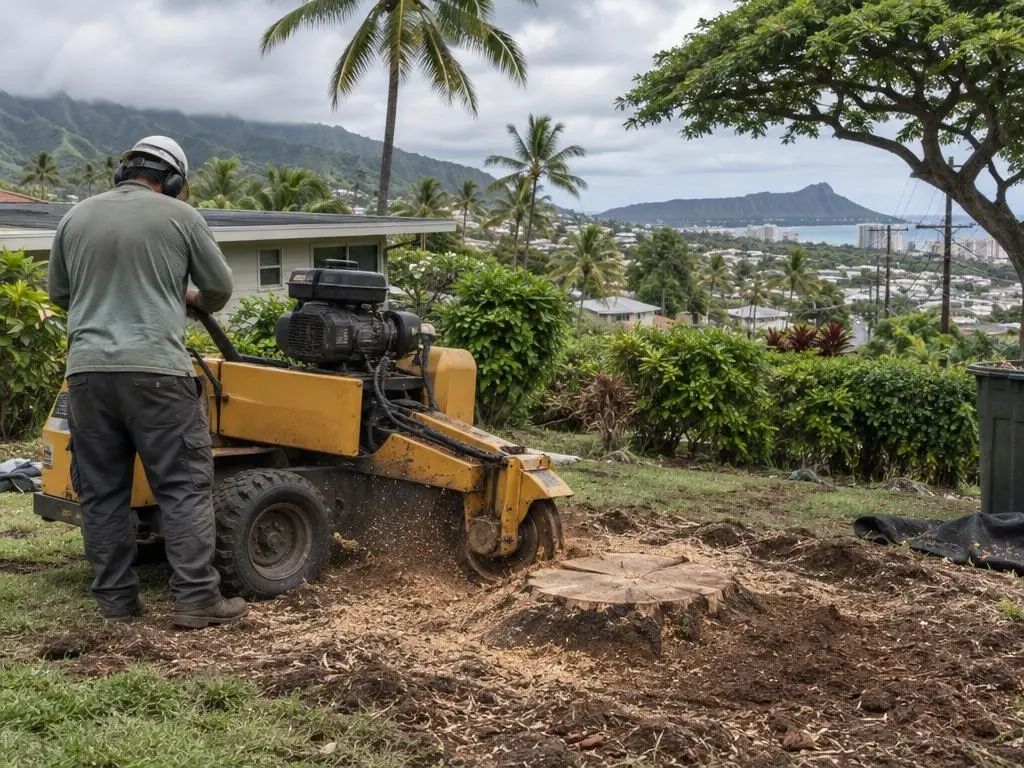
- Stump grinding after a removal so the yard can be replanted
- Trimming branches away from roofs, solar panels and the service drop
Associations and permits
Many Kapolei neighborhoods have community associations with landscaping rules. Check yours before removing a front-yard tree. On the county side, trees on the exceptional tree register need a permit before any crown or root work, and trees in the street right-of-way belong to the city. The county's parks department headquarters is right here at Kapolei Hale, which opened in 2001.
Palm caution on the Ewa side
Coconut rhinoceros beetle has been on this side of the island since the early years of the Oahu outbreak, with detections at Ewa Beach in 2014 and Kunia in 2017. If you see V-shaped notches in coconut fronds, report it. Avoid stockpiling palm debris or bringing in mulch from unknown sources.
Call (808) 746-9674 or fill out the form for a written estimate. Get a free estimate
Kapolei Facts
- Second urban center. The 1977 Oahu General Plan named Kapolei a second urban center. Residential construction began in the late 1980s on former sugarcane and pineapple fields, much of it Campbell Estate land.
- Seasonal dryness. Wikipedia's climate table lists about 0 inches of average July rain and about 3.1 inches in December. The record high is 96 degrees, set in August 2016.
- Rapid growth. The 2020 census counted 21,411 residents, up 41% from 15,186 in 2010. QuickFacts lists 11.2% of residents aged 65 or older and 3.20 people per household.
- Owner-occupied homes. QuickFacts (2020-2024) shows a 76.5% owner-occupancy rate and a median owner-occupied value of $744,200 across 6,906 households.
Kapolei Questions
My Kapolei tree drops leaves every summer. Is it dying?
Not necessarily. Many trees shed leaves in a dry spell to save water. Dead twigs, peeling bark or fungus at the base are better signs of trouble. We can take a look and tell you if it needs anything more than water.
Surface roots are lifting my pavers. Should I remove the tree?
Shallow rooting is common on graded, compacted ground. Sometimes the fix is a root barrier and a redesign of the hardscape. If the tree is too close to the house to save the slab, removal and stump grinding may be better.
Do you cover the newer Kapolei subdivisions as well as the older ones?
Yes. We work throughout Kapolei, from the first neighborhoods built in the late 1980s to the newest streets, and in Makakilo on the slopes above town.
Can you prune during the dry season?
Light pruning and deadwood removal are fine. For heavy reductions we may suggest waiting until the trees have had some rain.
Free Estimates in Kapolei, HI
Written estimates for Kapolei homes and associations.
Tree Service Near Kapolei
- Tree Service in Honolulu, HI
- Tree Service in Kailua, HI
- Tree Service in Kaneohe, HI
- Tree Service in Aiea, HI
- Tree Service in Pearl City, HI
- Tree Service in Mililani Town, HI
- Tree Service in Mililani Mauka, HI
- Tree Service in Ewa Beach, HI
- Tree Service in Ewa Gentry, HI
- Tree Service in Waipahu, HI
- Tree Service in Waipio, HI
- Tree Service in Wahiawa, HI
- Tree Service in Waimanalo, HI
- Tree Service in Makakilo, HI
- Tree Service in Royal Kunia, HI
- Tree Service in Halawa, HI
- Tree Service in Ahuimanu, HI
- Tree Service in Kahaluu, HI
- Tree Service in Hawaii Kai, HI
- Tree Service in Manoa, HI
- Tree Service in Kahala, HI
- Tree Service in Nuuanu, HI
- Tree Service in Haleiwa, HI